Case Study: How Machine Learning Algorithms Drive Smarter Business Decisions
- hoani wihapibelmont
- Aug 11, 2025
- 2 min read

Introduction
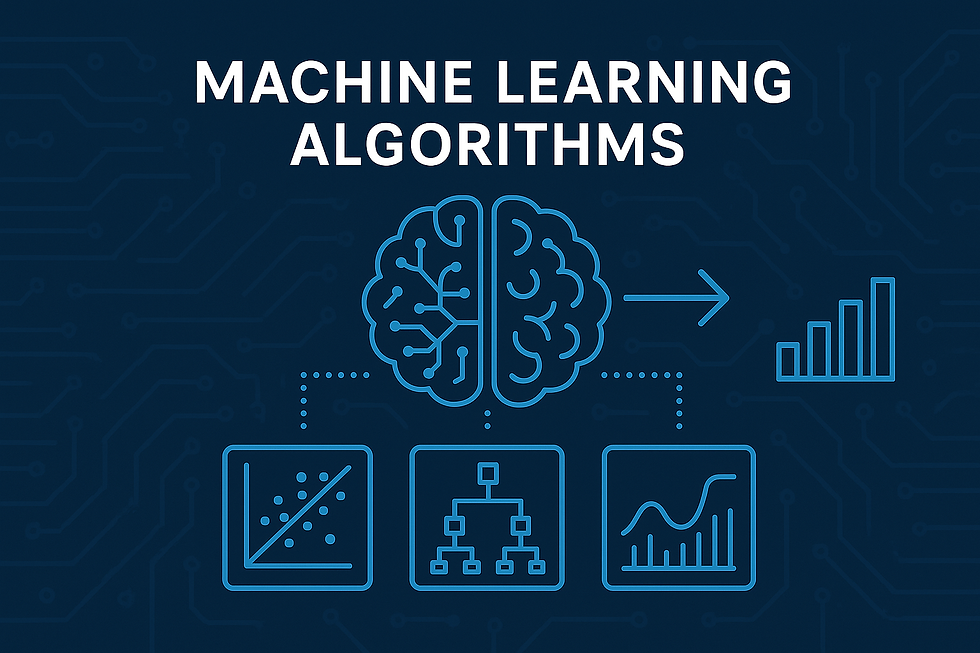
Machine Learning (ML) algorithms form the backbone of modern Artificial Intelligence. These algorithms enable systems to learn from data, identify patterns, and make predictions without being explicitly programmed for every scenario. From recommending your next Netflix show to predicting equipment failures in factories, ML algorithms are behind many of today’s most advanced digital services.
In this case study, we examine how a business leveraged ML algorithms to enhance operations, the tangible results it achieved, and where this technology is headed.
Background
Machine learning can be divided into key types:
Supervised Learning — training models with labeled data to make predictions (e.g., regression, classification).
Unsupervised Learning — finding hidden patterns without labeled outputs (e.g., clustering, dimensionality reduction).
Reinforcement Learning — agents learn by trial and error to maximize rewards.
Advances in ensemble methods, gradient boosting, and deep learning architectures have made ML more accurate and scalable than ever before.
Problem Statement
Before ML-driven approaches, organizations often relied on:
Manual data analysis, which was slow and prone to human bias.
Rule-based systems that couldn’t adapt to changing trends.
Missed opportunities for real-time decision-making.
Implementation Example
Case: A mid-sized logistics company used ML algorithms to predict delivery delays.
Tool: Gradient Boosting Decision Trees (GBDT) combined with real-time traffic and weather data.
Process:
Historical delivery records were used to train the model.
Live conditions (traffic congestion, road closures, weather) were fed in during predictions.
The system flagged high-risk deliveries and auto-adjusted routes.
Outcome: Reduced late deliveries by 28%, increased on-time performance, and saved over $1.2 million annually in penalties and fuel costs.
Impact & Benefits
Data-driven decisions at scale.
Increased accuracy through continuous model retraining.
Operational cost savings by identifying inefficiencies early.
Challenges
Data quality issues can drastically reduce accuracy.
Model interpretability — some algorithms work well but act as “black boxes.”
Ongoing maintenance — models need to be updated as conditions change.
Future Outlook
We can expect:
Explainable AI (XAI) to make ML models more transparent.
Automated Machine Learning (AutoML) to make development faster and more accessible.
Federated learning for privacy-first, distributed model training.


Comments