Case Study: How Multimodal AI Is Merging Text, Image, and Audio for Smarter, More Versatile Systems
- hoani wihapibelmont
- Aug 11, 2025
- 2 min read

Introduction
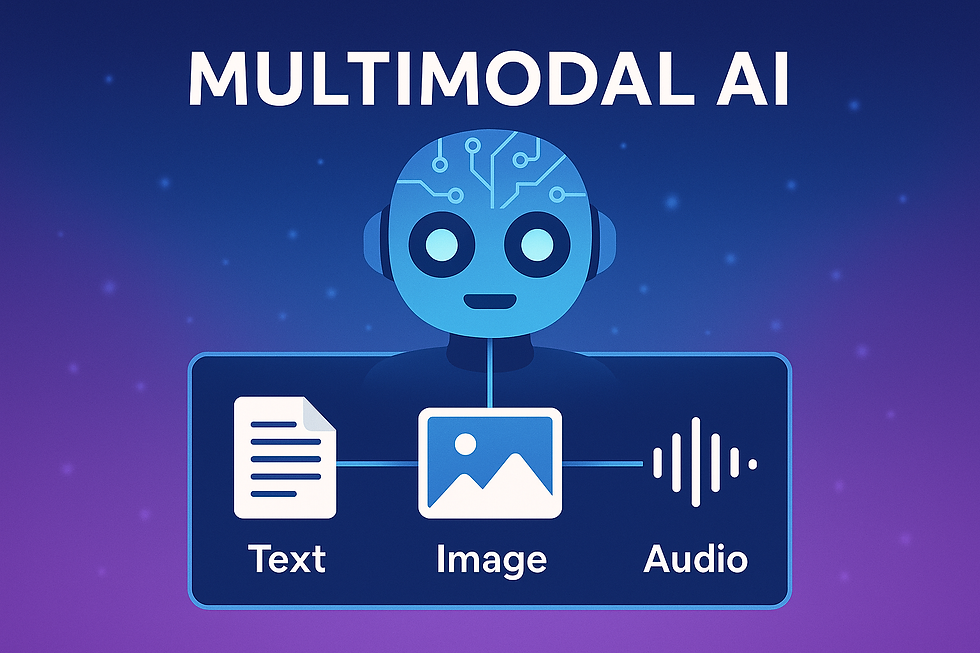
Multimodal AI represents the next leap in artificial intelligence — systems that can process and combine multiple types of input, such as text, images, and audio, into a unified understanding.
Unlike single-modality AI, which only handles one type of data, multimodal systems can interpret a photo, read its caption, and understand spoken context, all at once. This opens the door to advanced capabilities in education, accessibility, creative media, and autonomous decision-making.
Background
Key advances enabling multimodal AI include:
Vision-language models (e.g., CLIP, Flamingo) that link image and text understanding.
Audio-text models (e.g., Whisper) for speech recognition and transcription.
Fully multimodal architectures (e.g., GPT-4 with vision, Gemini) that can process all three simultaneously.
These models are trained on vast datasets containing combinations of text, images, and audio, allowing them to learn relationships between different data types.
Problem Statement
Before multimodal AI, applications faced:
Fragmented workflows — separate systems for text, image, and audio tasks.
Limited context awareness across media types.
Accessibility gaps for users needing cross-modal assistance (e.g., image descriptions for the visually impaired).
Implementation Example
Case: An online learning platform integrated a multimodal AI tutor.
Tool: Vision-language-audio model trained on educational datasets.
Process:
Students uploaded homework photos, dictated questions, or typed queries.
The AI analyzed the images, listened to the audio, and read the text to fully understand the problem.
Responses combined visual annotations, spoken explanations, and step-by-step written guides.
Outcome: Boosted student engagement by 41%, reduced support ticket volume by 34%, and increased lesson completion rates.
Impact & Benefits
Context-rich interactions combining all available information.
Accessibility improvements for users with disabilities.
Efficiency gains from unified systems instead of multiple separate tools.
Challenges
High computational demands for training and inference.
Complex data labeling for multimodal datasets.
Bias across modalities — issues in one input type can cascade into others.
Future Outlook
Expect to see:
Real-time multimodal assistants for live video and audio contexts.
Creative tools generating synchronized text, visuals, and soundtracks.
Industry-specific multimodal systems for fields like healthcare, manufacturing, and law.

Comments