Case Study: How AI in Manufacturing & Robotics Is Powering the Factories of the Future
- hoani wihapibelmont
- Aug 11, 2025
- 1 min read

Introduction
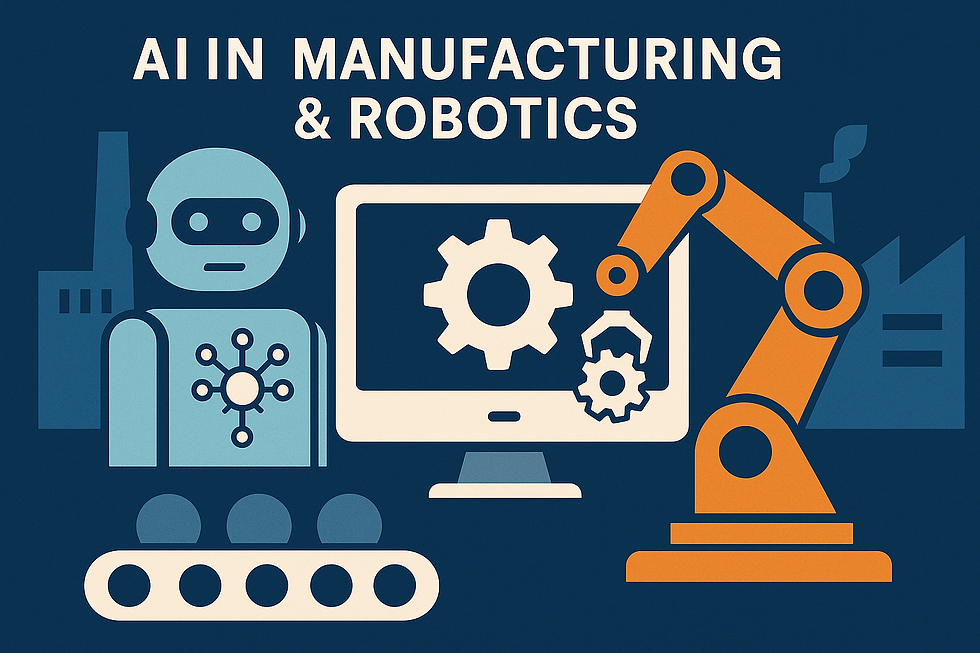
Artificial Intelligence is reshaping manufacturing by enabling robots and automated systems to make decisions, adapt to changing conditions, and optimize production processes. From predictive maintenance to fully autonomous assembly lines, AI is turning traditional factories into smart factories capable of running with minimal downtime and maximum precision.
Background
Key AI applications in manufacturing and robotics include:
Predictive Maintenance — ML models forecast equipment failures before they happen.
Computer Vision — automated quality inspection of parts and products.
Robotics Control Systems — AI-driven robots adapt in real time to new tasks.
Supply Chain Optimization — predicting demand and managing resources efficiently.
Problem Statement
Before AI, manufacturing operations faced:
Unplanned downtime from unexpected equipment breakdowns.
Quality control issues caused by manual inspection limitations.
Inefficient workflows due to static, pre-programmed robotic systems.
Implementation Example
Case: An automotive manufacturer integrated AI-driven robotics into their assembly line.
Tool: Computer vision + reinforcement learning-based robotic control.
Process:
AI inspected parts in real time for defects.
Robots automatically adjusted their assembly process based on detected variations.
Predictive maintenance alerts reduced downtime.
Outcome: Increased production efficiency by 27%, reduced defects by 42%, and cut maintenance costs by 18%.
Impact & Benefits
Higher production throughput with fewer defects.
Reduced downtime through predictive maintenance.
Greater adaptability to changes in product designs or demand.
Challenges
High initial investment for AI and robotics integration.
Skilled workforce requirement to manage and maintain advanced systems.
Cybersecurity risks in connected manufacturing networks.
Future Outlook
Expect to see:
Collaborative robots (cobots) working alongside humans safely.
Self-optimizing supply chains powered by AI predictions.
Full automation in lights-out factories running 24/7 without human presence.

Comments